Icon TunerDiT: Training-free Progressive Steering of Diffusion Transformer for Multi-Event Video Generation

1Ludwig Maximilian University of Munich   •   2Technical University of Munich   •   3MCML   •   4University of Hamburg   •   5Huawei European Research Institute

Abstract

Text-to-video (T2V) generation faces challenging questions when generating videos with long horizons containing multiple events. Inspired by the intrinsics of the diffusion process, we probe video diffusion transformers (DiTs) and uncover intrinsic turning points in the DiT denoising trajectory where conditioning text affects generation from global layout to fine-grained details. Building on this finding, we present TunerDiT, a simple yet effective progressive steering method that requires no additional training for multi-event generation. TunerDiT comprises two steering handles: (1) Event-Partitioned Masking that enforces event boundaries while allowing cross-event transition bands; (2) Cross-Event Prompt Fusion that injects neighboring event semantics for late-stage refinement. We contribute a self-curated prompt suite for benchmarking multi-event generation, i.e. Meve. TunerDiT achieves state-of-the-art performance across 8 metrics and offers a tunable trade-off between video consistency and event separation, compared with other training-free methods. The improvement in text alignment increases with the event count, indicating a scaling possibility with increasing event count.
First Row Ratio

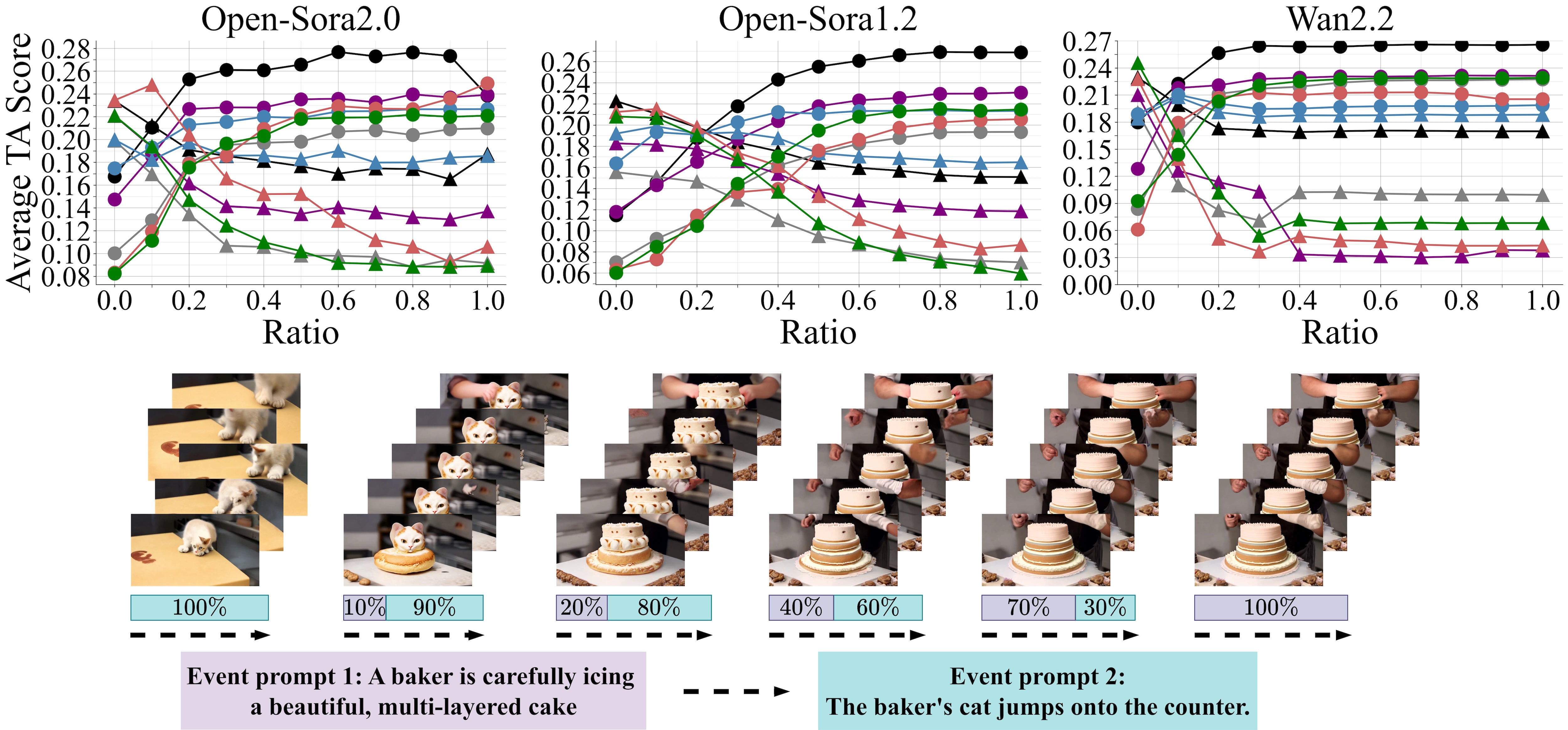
Fig. 1: Different denoising steps are utilizing text inputs differently. TunerDiT finds this insight by probing prompt conditioning of video diffusion models. When switching the input prompt at various fractions of the denoising steps (e.g., 0%, 10%, 20%, 40%, 70%, 100%), it is observed that early steps dominate the global layout while late steps refine fine-grained appearance and motion, revealing intrinsic turning points where text influence changes. Building on this insight, TunerDiT is a training-free, progressive steering method for video DiTs, yielding consistent multi-event videos with clear boundaries and smooth transitions.

Method Overview

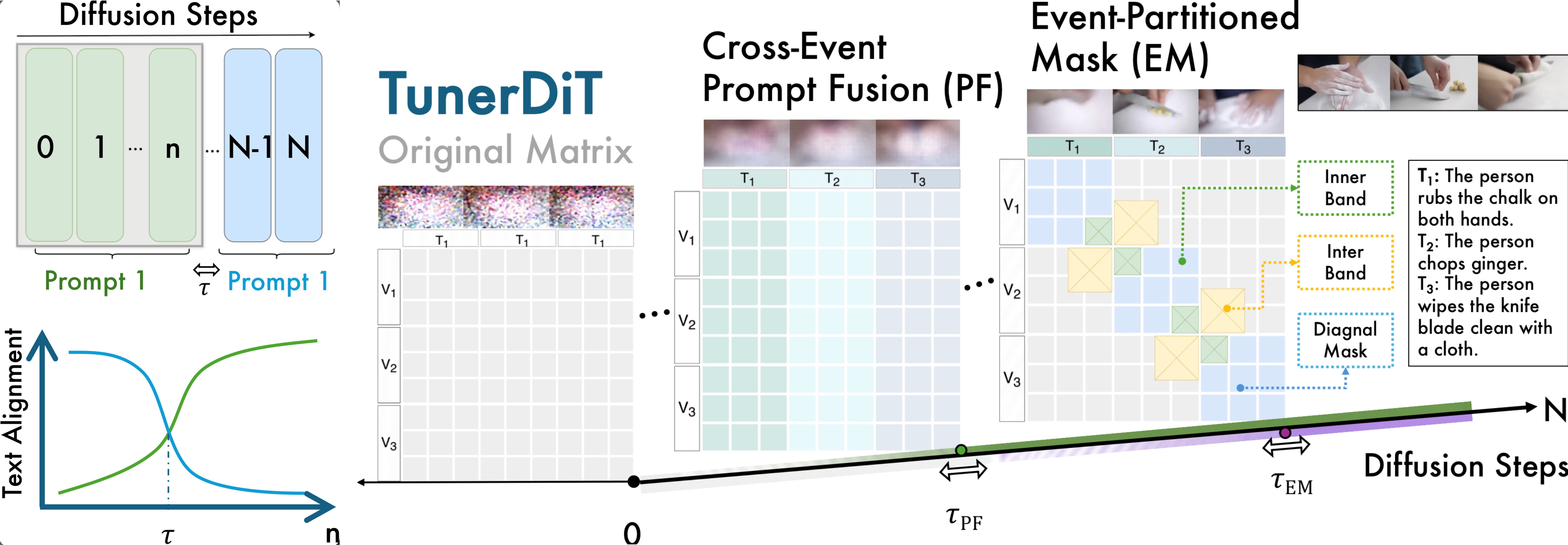
TunerDiT is a progressive coarse-to-fine steering framework for multi-event T2V generation that operates without training. It exploits intrinsic turning points in the DiT denoising process by intervening at the appropriate phase to first generate a shared layout of multiple events and refine inner event details at a certain later stage, utilizing two steering handles activated according to a schedule:

1. Cross-Event Prompt Fusion (PF)

A gating scheme that conditions video latents on event prompts to enhance semantic awareness and coherence.

2. Event-Partitioned Mask (EM)

A diagonal mask that isolates events with connecting bands across events on DiT attention layers. The mask design restrains DiT’s attention to enforce event boundaries and ensure smooth handovers.
Method Main Figure

Fig. 2: TunerDiT progressively steers multi-event generation over diffusion steps. Cross-Event Prompt Fusion (PF) first shares a common prompt to build a coherent layout, then gradually separates event prompts. Event-Partitioned Mask (EM) subsequently enforces event isolation via diagonal cross-attention blocks and introduces cross-event transition bands around boundaries, enabling smooth and semantically consistent handovers between events.

Multi-Event Qualitative Comparisons

Comparing TunerDiT with standard base models and existing training-free baselines across sequential events.

OpenSora 1.2

OpenSora 2.0

Wan 2.2

MEVG

DiTCtrl

Mask2DiT

TunerDiT (Ours)

Event Prompt: "A person is drinking a glass of water. Then the person starts cleaning the windows."

OpenSora 1.2

OpenSora 2.0

Wan 2.2

MEVG

DiTCtrl

Mask2DiT

TunerDiT (Ours)

Event Prompt: "A person is checking his phone. Then the person starts watering the plant. Then the person gently touches the leaves of a plant."

Quantitative Benchmarking on MEve

Quantitative comparison and preference-aligned evaluation. (a) Quantitative metrics across {TA, TIS, BC, IC, CSCV} and varying shot numbers {2, 3, 4}. (b) VLM-as-a-judge EI/TVA and human user study scores

(a) Quantitative comparison of different models across five metrics


Quantitative comparison of different models across five metrics.
Metrics with the highest value are highlighted in bold and the second best are underlined.

TA ↑ TIS ↑ BC ↑ IC ↑ CSCV ↑
Shot Number 2 3 4 2 3 4 2 3 4 2 3 4 2 3 4
Zero-shot Methods
MEVG 0.201 0.206 0.205 0.271 0.270 0.272 0.228 0.249 0.270 0.269 0.270 0.270 0.688 0.703 0.707
DiTCtrl 0.186 0.207 0.216 0.259 0.271 0.278 0.303 0.377 0.394 0.280 0.354 0.389 0.826 0.819 0.803
FreeNoise 0.197 0.199 0.206 0.272 0.267 0.275 0.275 0.401 0.431 0.273 0.372 0.428 0.732 0.743 0.748
Ours
TunerDiT Wan2.2 0.201 0.211 0.211 0.273 0.277 0.279 0.619 0.575 0.669 0.516 0.512 0.660 0.831 0.840 0.830
TunerDiT Open-Sora 1.2 0.202 0.211 0.213 0.277 0.284 0.281 0.508 0.472 0.496 0.452 0.452 0.460 0.848 0.839 0.844
TunerDiT Open-Sora 2.0 0.210 0.213 0.219 0.280 0.277 0.287 0.501 0.532 0.496 0.411 0.488 0.466 0.866 0.883 0.854

(b) Evaluation metrics with human preference alignment


Left: VLM-as-a-judge for Event Isolation (EI) and Text-Video Alignment (TVA);
Right: Human user study scores (18 persons).

Name EI TVA
Zero-shot Methods
MEVG 0.435 1.375
FreeNoise 0.436 1.400
DitCtrl 0.375 1.425
Ours
TunerDiT Wan 2.2 0.474 1.503
TunerDiT Open-Sora 1.2 0.499 1.492
TunerDiT Open-Sora 2.0 0.572 1.533
Model Q1 Q2 Q3 Q4
Zero-shot Methods
MEVG 1.82 1.91 1.82 2.05
FreeNoise 1.99 2.01 1.99 1.79
DiTCtrl 2.11 2.03 2.18 2.35
Ours
TunerDiT Wan 2.2 3.01 2.97 2.82 3.30
TunerDiT OpenSora 1.2 2.66 2.63 2.62 2.94
TunerDiT OpenSora 2.0 3.16 3.03 3.03 3.34

BibTeX

@misc{liao2026tunerdittrainingfreeprogressivesteering,
      title={TunerDiT: Training-free Progressive Steering of Diffusion Transformer for Multi-Event Video Generation}, 
      author={Ruotong Liao and Guowen Huang and Qing Cheng and Guangyao Zhai and Lei Zhang and Xun Xiao and Thomas Seidl and Daniel Cremers and Volker Tresp},
      year={2026},
      eprint={2605.31590},
      archivePrefix={arXiv},
      primaryClass={cs.CV},
      url={https://arxiv.org/abs/2605.31590}, 
}